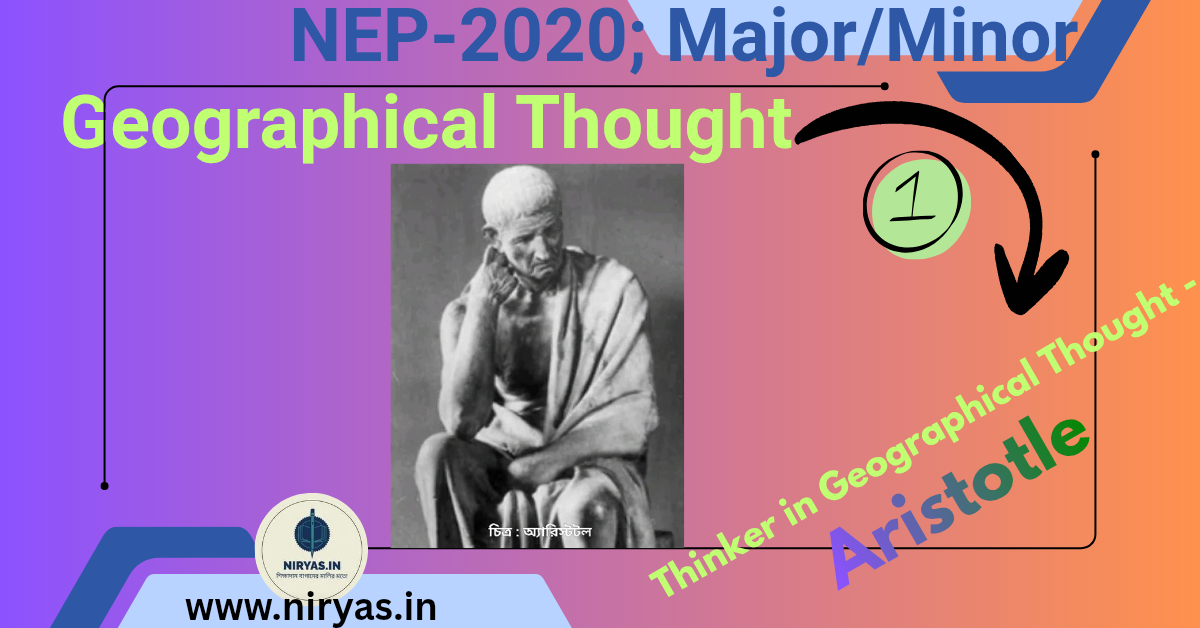
Thinker in Geographical Thought-Aristotle in Eng
Thinker in Geographical Thought – Aristotle
According to NEP 2020, the syllabus has been changed at the university level. New content has been added. Several changes are also noticeable in the subject of geography. The syllabus of the subject of development of geographical thought has also been updated, it has got a touch of modernity. According to the syllabus, the books required for the development of geographical thought are almost insufficient. In an attempt to overcome this predicament, our smallest attempt to develop geographical thought is the post named Thinker in Geographical Thought – Aristotle.
Thinker in Geographical Thought – Aristotle
Aristotle (384-322 BCE): ‘Aristotle was the last great figure in the distinguished philosophical tradition that began in ancient Greece around the sixth century BC with the works of Thales (625-548 BCE).’❶ Of course, Greek philosophy did not end with Aristotle; rather, it flourished for several centuries through the Epicureans, Skeptics, and Stoics, as well as Plato’s Academy and Aristotle’s own Peripatetic schools in Athens and elsewhere until the first century of the Byzantine Empire. Aristotle was born in 384 BC (Olympics 99.1) in Stagiros (later Stagira), a small Greek port city in the Chalcidice region of the northern Greek district of Chalcidice, about 164 years after the death of Thales and about 24 years after the death of his contemporary predecessor Herodotus. His father was Nicomachus❷,❸ and his mother was Phaestias❸. Aristotle’s father was the court physician to King Amyntas II of Macedon. Aristotle spent some of his childhood at the Macedonian palace at Pella, establishing a connection with the Macedonian monarchy that lasted throughout his life. When both of Aristotle’s parents died when he was young, his upbringing was entrusted to a family relative named Proxenos. Proxenos sent him to the famous school in Athens founded by Plato for his education. At the age of 17, Aristotle came to Plato’s school called the Academy and studied there for the next 20 years. Aristotle was one of the greatest philosophers and scientists the world had ever known. He was 43 years younger than Plato and 62 years younger than Herodotus. Laertius described Aristotle as “the most eminent of all the pupils of Plato” -D.L. ❸. When Plato died (347BC) while Aristotle was on an embassy to King Philip of Macedonia on behalf of the Athenians, Xenocrates became president of the Academy. Upon his return from Philip’s embassy, he found that the executive power of the Academy had been transferred to someone else, so he left the school and, at the invitation of his friend Hermias, king of Atarneus, went to Asia Minor and devoted himself to scientific research in biology and natural history for about five years. After five long years, in 342 BC, he arrived at the court of Philip II, son of Amyntas II, the then king of Macedonia, and was appointed as the tutor of his thirteen-year-old son Alexander. After serving as a royal tutor there for two years, he returned to his native Stagira in 340 BC. In 336 BC, after Philip II was stabbed to death by his bodyguard Pausanias of Orestis, Alexander established himself as king of Macedonia. At this time, he returned to Athens from Stagira under the patronage of Antipater, the representative of Athens appointed by the new king Alexander, and at the age of 49, with the financial support of his student and the Persian ruler Alexander, he established his own school, the Lyceum, near the temple of Apollo Lycius in Athens around 335 BC. He taught philosophy while walking with his students in the school he founded (…“in which he used to walk up and down with his disciples, discussing subjects of philosophy till the time for anointing themselves came;on which account he was called a Peripatetic” (Diogenes Laertius V.2). His school soon became known as the “Peripatetic School” for teaching while walking (the word Peripatetic means mobile). He taught here for the next 13 years ❸. After the death of Alexander in 323 BC, the people of Athens, led by Antipater, decided to go to war with Macedonia. At this time, when Aristotle was accused of living in Athens immorally, he left Athens to escape the persecution of the Athenians and moved to his mother’s homeland, Chalcis, and He began to live in Euboea under the protection of a woman named Herpilis. Within a year, in the summer of 322 BC (Olympiad-114.3), he died in Euboea at the age of 63 from a poison called Draught of Aconite❸.
Thinker
⟽ Previous Post : Principals of GNNS Positioning in Geographical Thought
Aristotle and his works: Aristotle, a disciple of Plato, was a multi-talented personality. He was the teacher of Alexander and also the teacher of Theophrastus and Hipparchus at the Lyceum school he founded. He wrote about 400 (385+) books during his lifetime, which include 4,45,270 lines❸. But most of his writings are no longer available. Some of his famous books are: “Historia Animalium” (History of Animals), “De Anima” (On the Soul), “Metaphysica” (Metaphysics), “Meteorologica” (Meteorology), “Politica” (Politics), De Caelo (On the Heavens) etc. Thinker in Geographical Thought
Aristotle discusses biology, zoology and natural history in his book “Historia Animalium“. In this book, he provided ideas about the classification, anatomy, physiology, behavior and habitat of animals. He included more than 500 species of animals, including mammals, birds, reptiles, amphibians and insects, in his discussion. His book is considered one of the oldest works in biology, through which the foundation of later scientific research on animals was laid.
Aristotle’s book “De Anima” was the subject of philosophy, psychology and biology. In this book, he discussed the nature of the soul, the relationship between the soul and the body, the types of souls (vegetative, sensitive, rational), etc. At the same time, he explored the concept of the soul in living creatures from plants to humans. Through this book, later Western philosophical and scientific thought on the nature of life and consciousness was influenced.
Aristotle’s “Metaphysica” discusses the nature of reality, being, matter, causation, possibility, and actuality as topics within philosophy and metaphysics. He explores the fundamental principles of existence, reality, and knowledge through this book. This book is considered one of Aristotle’s most important works, which later influenced Western philosophical thinking on metaphysics and theology.
In his book “Meteorologica“, Aristotle discusses the topics related to geology, meteorology, geography, weather, climate, atmosphere, oceans, earthquakes, and natural phenomena. The aspects of the Earth’s atmosphere and natural phenomena that he discusses in this book are quite significant in the development of current meteorology and geoscience, and some ideas are still used today.
Aristotle discusses politics, philosophy and ethics in his book “Politica” on the nature of politics, forms of government, justice, citizenship and the ideal state, etc. Thinker in Geographical Thought
The issues he raises in his discussion through the exploration of the organization and governance of human society are considered a fundamental work of political philosophy in the present period. The influence of his works on current Western thinking on politics and governance is noticeable.
In his book “De Caelo“, Aristotle presents explanations related to the structure of the universe, the shape and position of the Earth, cosmic objects, ether, etc. as topics of discussion including cosmology, astronomy, philosophy, etc. His discussion has been influencing Western thinking in the field of cosmology and astronomy for centuries. Although his geocentric model of the universe was later rejected by Copernicus and Galileo. ……………………Thinker in Geographical Thought
Thinker in Geographical Thought – Aristotle
References :
❶”Aristotle’s Life”; Georgios Anagnostopoulos; 2008
❷”History of Philosophy, From Thales to the Present Time”; Dr. Friedrich Uberweg; 1899
❸”Lives of Eminent Philosophers”; Diogenes Laertius
Discover more from NIRYAS.IN
Subscribe to get the latest posts sent to your email.

